.png?width=180&height=47&name=CL_Blue_Horizontal_Web%20(1).png "consafe logistics logo blue")
Conveyors, shuttles, robots, AMRs… the list of warehouse automation technologies keeps growing. But how do you know which one is right for your warehouse? Before comparing technologies, start by understanding the operational problem you want to solve.
This guide explains the main warehouse automation types, the warehouse functions they support, how different warehouse automation systems compare, and what to consider before investing.
Whether you manage a single distribution center, a growing e-commerce operation, or a multi-client 3PL environment, this article will help you build a clear automation landscape.
What are the main types of warehouse automation?
When people think about warehouse automation, they often think about specific technologies. However, these technologies are simply tools designed to do specific tasks. A more important question to ask is: "What do I want to achieve?"
Rather than starting with a specific technology, it's more helpful to group automation solutions by the tasks they perform. Once you understand which warehouse process needs improvement, you can identify the automation technology that best addresses that challenge.
What tasks do each automation type perform?
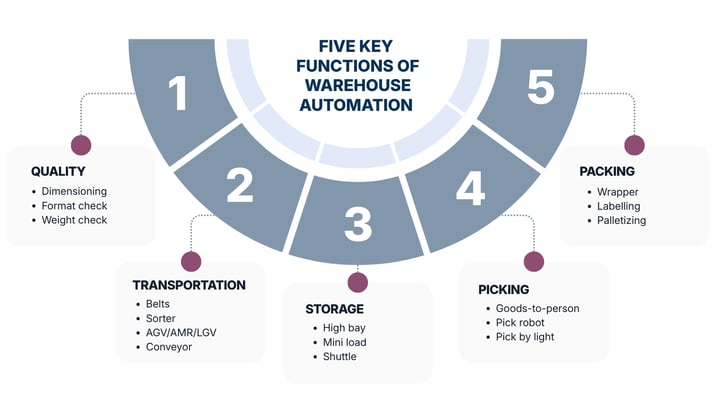
The five main categories are:
- Transportation
- Storage
- Picking
- Packing
- Quality control
Transportation
Transportation automation moves products efficiently throughout the warehouse.
Typical solutions include:
- Conveyors
- Belt systems
- Sorters
- Automated Guided Vehicles (AGVs)
- Autonomous Mobile Robots (AMRs)
- Laser Guided Vehicles (LGVs)
This type of automation helps reduce manual transport, improve material flow, and minimize unnecessary travel throughout the facility.
Storage
Storage automation maximizes warehouse capacity while improving inventory accessibility.
Typical solutions include:
- Automated Storage and Retrieval Systems (AS/RS)
- High-bay warehouses
- Shuttle systems
- Mini-load systems
These solutions are particularly valuable when warehouse space is limited, or high storage density is required.
Picking
Picking automation improves one of the most labor-intensive warehouse activities.
Common solutions include:
- Goods-to-person systems
- Pick-to-light
- Pick-by-light
- Robotic picking systems
The goal is typically to increase picking productivity, improve accuracy and reduce physical strain on operators.
Packing
Packing automation helps standardize outbound processes.
Examples include:
- Automatic wrapping
- Labelling systems
- Palletizing robots
These solutions improve consistency and/or reduce manual handling during shipping.
Quality control
Quality automation verifies products before they leave the warehouse.
Typical technologies include:
- Weight checks
- Dimensioning systems
- Format verification
These systems help detect errors early and improve delivery quality.
How do the different warehouse automation types compare?
Once you've identified the problem you want to solve, the next step is evaluating warehouse automation technologies. The question you should ask at this phase is: “How do I want to design automation in my warehouse?”
Two important dimensions help compare solutions:
1. Physical flexibility (Fixed → Flexible)
Warehouse automation can range from fixed to flexible solutions. Some automation is permanently installed within the warehouse, while other solutions can be reconfigured much more easily.
For example:
- Conveyors require physical installation and can be costly to modify.
- AMRs can often follow new routes simply through software configuration.
Both solve transportation challenges, but they offer very different levels of flexibility.
2. Integration level (No integration → Tightly integrated)
Warehouse automation can also range from standalone equipment with little or no integration to tightly integrated solutions that exchange information in real time.
Some equipment operates largely on its own, while other solutions exchange real-time information with warehouse software and other automation.
Tightly integrated solutions often enable greater efficiency and better coordination, but they also increase system complexity.
What limitations or challenges come with each automation type?
Every automation investment involves trade-offs. Warehouses rarely remain unchanged throughout their lifetime. Your products evolve, your customers’ requirements shift, regulations change, and your business models develop. The warehouse building itself is often the only constant.
Choosing a highly fixed solution may deliver excellent performance today but limit future flexibility. On the other hand, highly adaptable solutions often require greater investment.
Rather than asking which technology is "best," you should consider how easily your automation can support future operational changes.
What does each automation type typically cost or what drives the cost?
The cost of automation depends on far more than the equipment itself. In general, investment increases when:
-
More systems need to be integrated
-
More custom business logic is required
-
The solution is heavily customized
Standardized, ready-packaged solutions are often less expensive than fully customized installations, because they require less engineering and configuration.
The right investment depends on balancing today's operational needs with tomorrow's flexibility.
Which types of automation are best for high-volume operations?
There is no single answer. High-volume warehouses don't automatically require one specific automation technology. The right choice depends on the operational bottleneck.
For example, your warehouse may need to improve:
- Picking capacity
- Buffer storage
- Transportation
- Replenishment
Each challenge may require a different approach to automation.
Even warehouse automation technologies commonly associated with high-volume environments are not always the best fit. Some storage systems perform exceptionally well when a relatively small percentage of SKUs accounts for most order activity, while other operations benefit from entirely different solutions.
The starting point therefore should always be your operational problem, not the technology.
Which types of automation are suitable for 3PLs or multi-client environments?
Third-party logistics providers typically operate in rapidly changing environments. Customers, products, order profiles, and contracts can all change frequently. Because of this, many 3PLs prioritize automation that is:
-
Flexible
-
Easy to reconfigure
-
Future-proof
Technologies such as AMRs and AGVs can often be adapted without major infrastructure changes, making them well suited for dynamic warehouse environments. However, flexibility often comes at a higher cost, so finding the right balance between adaptability and investment is essential.
How do these automation types integrate with WMS or WCS systems?
Integration is critical across all warehouse automation systems because physical automation should not operate in isolation. The three key software layers are:
- Warehouse Management System (WMS): acts as an overall order planner and high-level resource supervisor for manual and automated parts of the warehouse
- Warehouse Execution System (WES): acts as a coordination layer between the manual and automated parts of the warehouse
- Warehouse Control System (WCS): acts as a flow control engine and load balancer for the automation equipment
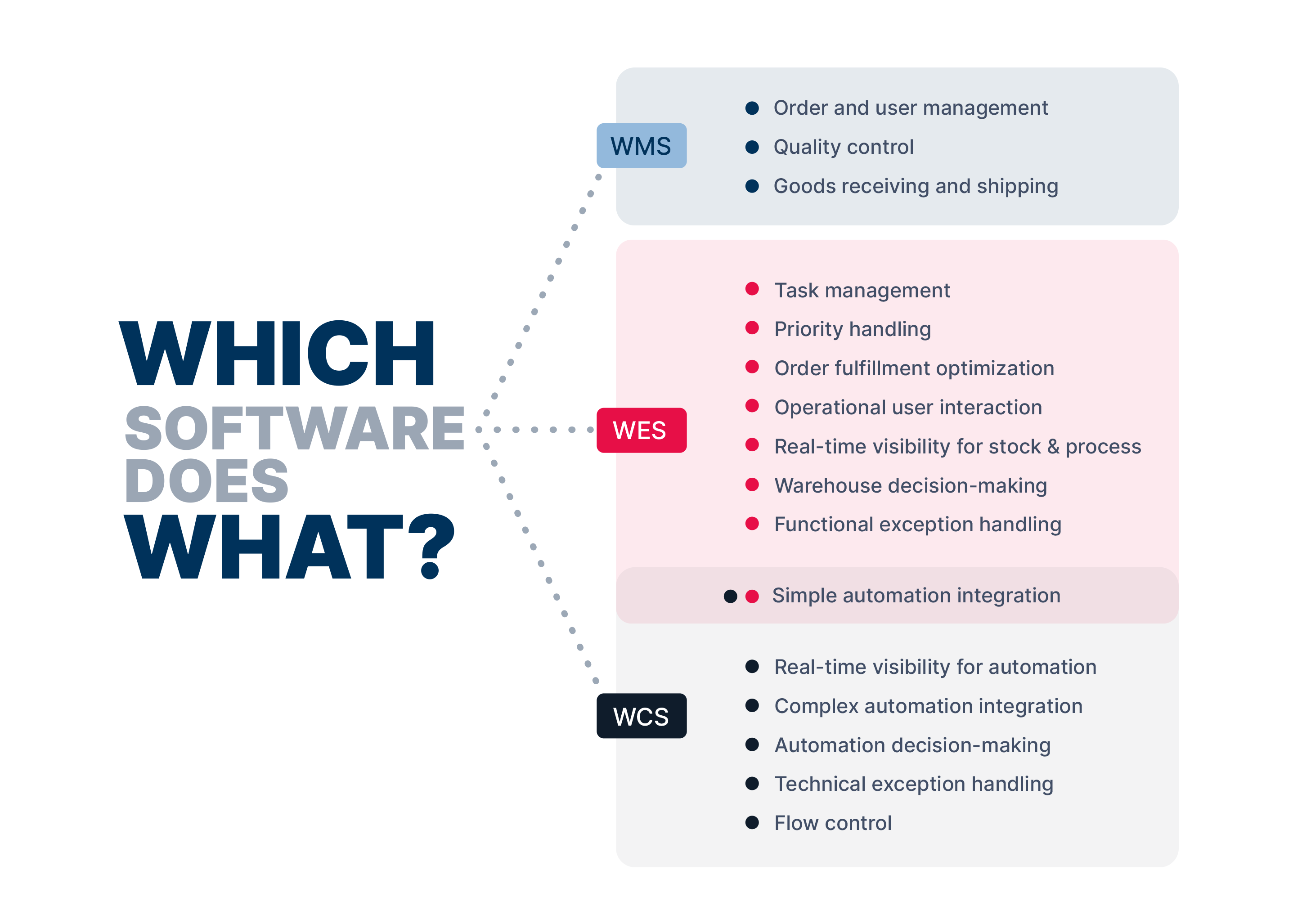 Together, the WMS, WES, and WCS ensure that automation operates as one coordinated system, connecting both manual and automated processes across the warehouse.
How does each automation type impact KPIs such as accuracy, throughput, labor cost and lead times?
Every type of automation has the potential to improve warehouse performance when chosen correctly. Well-selected automation can improve:
-
Picking accuracy
-
Throughput
-
Labor productivity
-
Lead times
-
Overall operational quality
The technology itself doesn't guarantee better KPIs. Success depends on correctly identifying the bottleneck and selecting automation that addresses the root cause rather than simply following industry trends.
One piece of advice is to keep an open mind throughout the selection process. While you know your operation best, experienced automation vendors have seen similar challenges across many warehouses and may suggest solutions you haven't considered.
What warehouse profiles are best suited for different automation technologies?
Every warehouse is unique, but some general patterns exist.
- High-volume distribution centers often benefit from automation that increases throughput for their specific bottleneck.
- E-commerce fulfillment frequently combines storage automation, picking automation, and flexible transportation solutions to handle changing order profiles.
- 3PL operations usually prioritize adaptable automation that can support changing customer requirements.
- Brownfield warehouses often introduce automation gradually through modular projects rather than complete warehouse rebuilds.
What are the emerging trends in warehouse automation?
Several trends are shaping warehouse automation today:
- More companies are investing in picking automation
- Greenfield warehouse projects increasingly target lights-out operations with minimal manual intervention
- More warehouses are combining people and automation, particularly in brownfield facilities
- Rather than fully rebuilding existing warehouses, many companies are introducing targeted automation that delivers measurable improvements while allowing operations to continue
What should companies consider before choosing one automation type over another?
Technology should always follow your business problem. Before evaluating automation solutions, ask:
- What problem are we trying to solve?
- Where is the operational bottleneck?
- What is causing that bottleneck?
- Could the root cause be solved differently?
- How much do I think the future will change?
Sometimes removing the underlying cause of a problem delivers greater value than investing in additional automation.
And remember: every warehouse is different. Rather than copying another company's solution, focus on understanding your own operation and selecting automation that supports your long-term business goals.